Table of contents
Factories are being asked to do more with less: shorter delivery windows, tighter energy targets, and a workforce that often changes faster than the equipment does. In that squeeze, modular process skids have quietly moved from “nice-to-have” engineering shortcuts to a core strategy for scaling and modernising plants without endless shutdowns. Across food, chemicals, water, and energy, field teams report the same shift, skids are no longer isolated islands, they are becoming connected building blocks for smarter factories.
When downtime costs more than steel
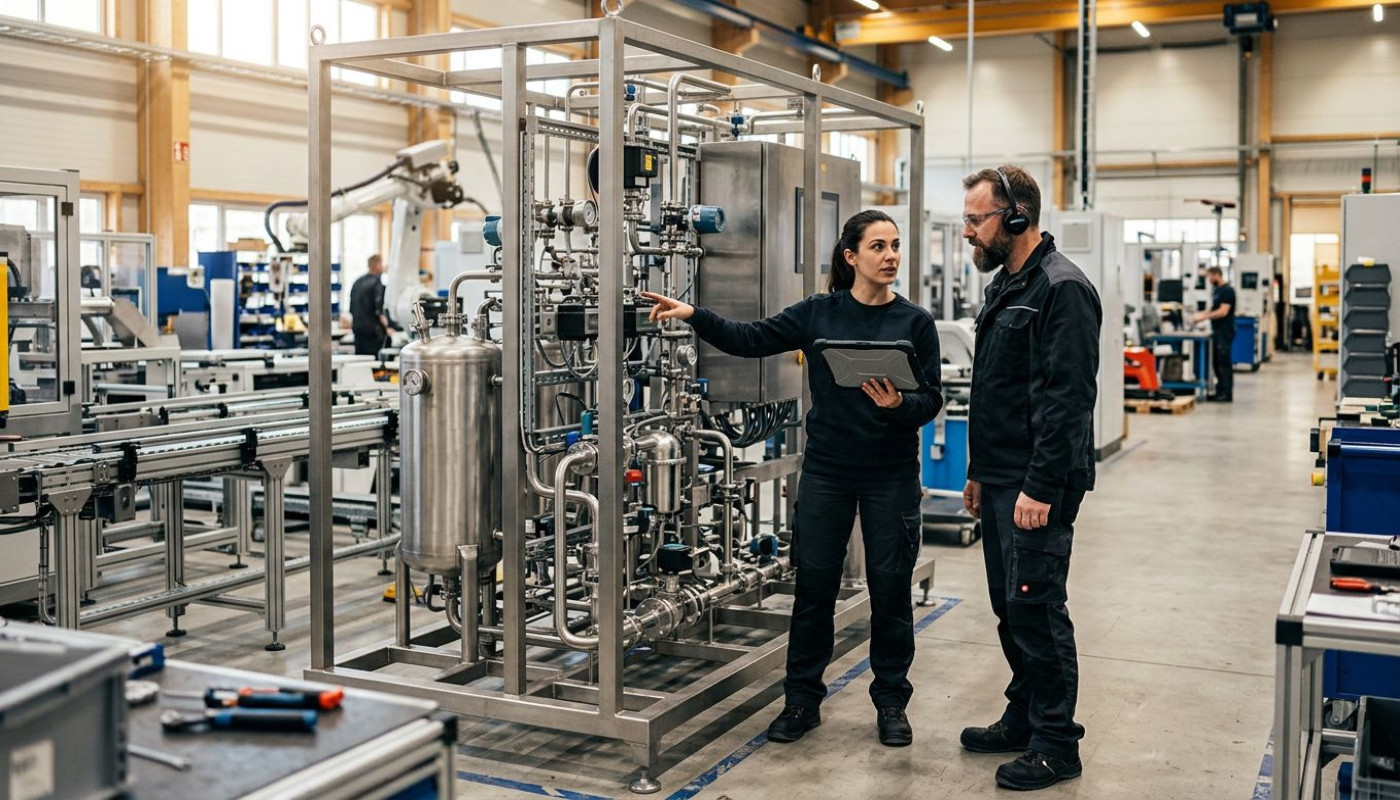
How much is one lost hour worth? For many continuous or semi-continuous sites, it is not just a line on a maintenance report, it is a direct hit to revenue, quality stability, and customer confidence. That reality is one reason modular skids have gained traction, because they move work away from the critical path, and into controlled workshops where fabrication, wiring, instrumentation, and testing can happen in parallel with ongoing production. In practical terms, that often means fewer hot works in tight plant corridors, less congestion with multiple contractors, and a shorter commissioning window once the skid arrives on site.
The economic logic is reinforced by a wider industrial trend: capital projects are being broken into smaller, faster decisions. Instead of a single multi-year retrofit, plant owners increasingly prefer phased upgrades that deliver incremental capacity, efficiency, or compliance gains. Skids fit this “step-by-step” approach, and they also reduce rework risk, because interfaces, piping routes, cable trays, and control cabinets can be validated earlier. It is the same principle that made prefabrication standard in other sectors, except here the stakes are process stability and safety, not just construction speed. What changes in the field is simple, teams spend less time improvising on site, and more time executing a plan that has already been proven in a test bay.
The skid becomes a data-producing asset
Automation used to stop at the control cabinet. Today, the expectation is that every new piece of equipment arrives instrumented, addressable, and ready to talk, not just to the PLC, but to historians, energy dashboards, and maintenance systems. That is where modern skids are evolving: they are being designed as data-producing assets, with consistent tag structures, embedded metering, and documentation that supports digital handover. The point is not to “digitalise” for its own sake, it is to shorten the distance between what the process is doing and what the factory knows.
In the field, this has concrete consequences. A skid that ships with calibrated flow, pressure, and temperature measurement, plus vibration or motor current monitoring where relevant, can feed predictive maintenance routines sooner, and it can make energy use visible at a granular level. Sites pursuing ISO 50001-style energy management, or simply trying to reduce utility bills, increasingly ask for sub-metering on compressed air, steam, or thermal loops, because without measurement, optimisation is guesswork. The smartest projects also treat software and documentation as part of the deliverable, structured I/O lists, FAT reports, loop checks, and cyber-hardening requirements move upstream, and that reduces last-minute integration surprises. When skids are managed through a hub model, where standard modules and interfaces are reused, the data layer becomes more consistent, and the plant gains the ability to compare performance across lines, shifts, or even sites.
Field stories: speed is only half the win
Speed sells, but it is not the whole story. In several real-world retrofit scenarios, teams describe the same pattern: the schedule benefit of skids is obvious, yet the deeper advantage is repeatability. When a process step is packaged into a module, including piping, instruments, valves, and controls, the factory gets something closer to a product than a one-off build. That means spare parts strategies become clearer, troubleshooting is faster because layouts are familiar, and operators can be trained on a consistent human-machine interface instead of a patchwork of legacy screens.
Another recurring lesson from the field is that “plug-and-play” is earned, not promised. The projects that go smoothly are the ones that invest early in interface definition: tie-in points, utility requirements, control philosophy, safety instrumented functions, and acceptance criteria. Commissioning then becomes verification rather than discovery. It also changes how quality and compliance are handled, especially in regulated sectors such as food and pharmaceuticals, where traceability, weld logs, material certificates, and cleanability requirements can determine whether a line can restart on time. Packaging a skid in a controlled environment supports that documentation discipline, and it reduces the variability that tends to appear when work is rushed during shutdowns. For manufacturers looking at modularisation at scale, the emerging best practice is to centralise know-how in a dedicated coordination model, where standard designs are curated, suppliers are qualified, and lessons learned are captured and reused, an approach exemplified by the aventech Group through its skid-focused hub strategy.
What smarter factories demand next
The next wave of “smart factory” expectations is less about flashy dashboards and more about industrial discipline: cybersecurity, lifecycle support, and measurable performance. As skids become more connected, they also become part of the plant’s attack surface, so procurement teams increasingly ask for hardened remote access, patch management plans, and clear responsibility boundaries between OEMs, integrators, and site IT/OT teams. The same shift is visible in contracts, where performance guarantees, documentation deliverables, and service level commitments are written with more precision than they were a decade ago.
There is also a sustainability angle that is becoming hard to ignore. Energy prices remain volatile, water constraints are rising in many regions, and reporting requirements around carbon are tightening. Skids can help here, not by magic, but because they enable targeted upgrades, a high-efficiency pump set, a heat recovery loop, a more precise dosing package, and they can be installed quickly enough that payback is not delayed by long outages. In other words, modularisation can accelerate decarbonisation and resource efficiency, provided the project defines the metrics that matter, kWh per unit, water per batch, rejects per shift, and then equips the skid to measure and improve them. The factories that will look “smarter” in 2027 will be the ones that can prove, line by line, that they run cleaner, steadier, and with less surprise.
Planning the next shutdown, without gambling
Start with a site walk and a tie-in map, then reserve fabrication slots early, because workshop capacity often sets the real schedule. Budget not only for the skid, but for utilities, civil works, and validation. Check local and national support schemes for energy efficiency, water savings, and industrial modernisation, they can materially improve payback when instrumentation and metering are included.
On the same subject

Exploring the Comeback of Hoverboards

Electric Supercharged: A New Era in Performance Cars

Finding Hidden Gems in Classic Car Parts Journals

The top vehicles that are in mode

Why invest in a vehicle?

Some benefits of having a personal vehicle

Vehicle: a secured means of transportation
